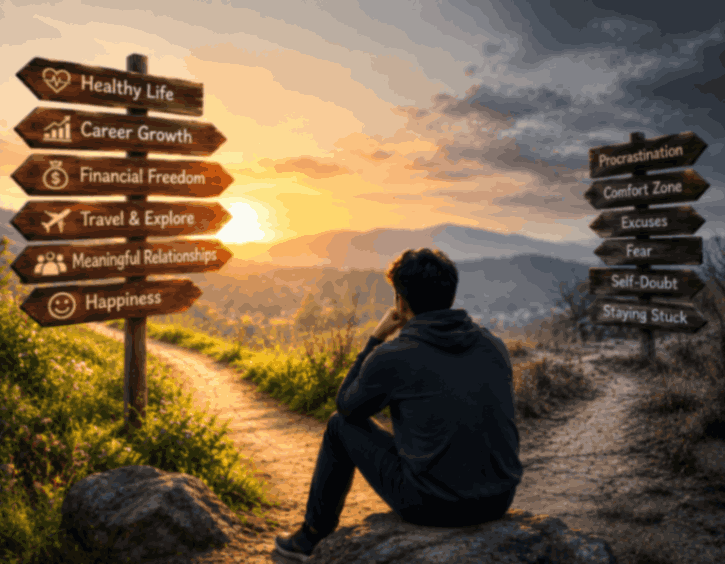
"Don't confuse unfamiliar with impossible. Your next life may initially feel foreign to you. Walk towards it anyway."
— Jacob PhilipSomething interesting happened on my farm recently. Two stray dogs appeared. I don't know exactly where they came from or what their lives had been like before reaching us. But they stayed.
And naturally, I started feeding them. I already have dogs at home. They eat surprisingly well — chicken, idli, dog food and whatever else they have become accustomed to over the years. So I gave the two newcomers dog food. Good food.
They walked towards it. Smelled it. And walked away. I tried again. Same response. They were hungry. Food was sitting directly in front of them. Yet they wouldn't eat it. That got me thinking.
Maybe They Didn't Recognise "Better"
These dogs had survived differently. Perhaps scraps had become food. Perhaps leftovers had become food. Perhaps whatever they could find on the street had become food. Then suddenly somebody puts something different in front of them and says: This is for you.
But how would they know? What was normal for my dogs wasn't normal for them. And that's when the dogs stopped being the interesting part of the story. I started thinking about us.
Key Insight
We often assume that if something better appears, we will choose it. But human beings don't always work that way. Sometimes we don't choose what is better. We choose what we recognise.
How Much of Our Life Is Simply Familiarity?
We often assume that if something better appears, we will choose it — a better opportunity, a better habit, a healthier relationship, a new career, a chance to learn, or a different way of thinking. But human beings don't always work that way. Sometimes we don't choose what is better; we choose what we recognise.
The Job & Excuses
Staying in predictable work or repeating familiar excuses because we know how to live there.
The Same People
Surrounding ourselves with familiar mindsets and routines, even when holding us back.
Comfortable Self
Choosing an old version of ourselves — not because it's good, but because it feels familiar.
Familiar Is Not the Same as Good
This distinction matters. Something can be familiar and still be holding you back. You can become accustomed to procrastination. Accustomed to being underpaid. Accustomed to saying, "I'll start tomorrow." Accustomed to blaming circumstances. Accustomed to believing: This is just who I am.
Repeat something long enough and it can stop feeling like a choice. It starts feeling like an identity. And identity is difficult to challenge because changing your life eventually requires changing the person you've become comfortable being.
The New Life May Feel Wrong Before It Feels Right
This is one of the strange realities of transformation.
The first time you wake up early, it feels uncomfortable.
The first time you speak confidently, it may feel unnatural.
The first time you set a boundary, you may feel guilty.
The first time you learn a completely new skill, you may feel incompetent.
The first time you walk into a room occupied by people operating at another level, you may wonder whether you belong there.
So you retreat back to what you know. And then we make a dangerous mistake: we interpret unfamiliarity as evidence that something isn't for us. Perhaps the opposite is sometimes true — unfamiliarity is evidence that you've reached the edge of your current identity.
Transformation Requires Exposure
A new way of living doesn't become normal because you read about it once. You have to experience it again and again. You take the first small action. Then another. You learn. You fail. You adjust. You return.
Eventually, something remarkable happens:
Becomes Familiar
What once felt foreign and awkward slowly starts feeling like home.
Becomes Routine
What required conscious willpower starts becoming automatic behavior.
Becomes Normal
And the person you were trying to become starts becoming the person you are.
So Here's the Question
The two dogs made me ask myself something I think is worth asking yourself too: What are you rejecting simply because it is unfamiliar?
Not because it's bad. Not because you can't do it. Not because it isn't meant for you. Simply because your previous life hasn't prepared you to recognise it yet.
Look carefully. Because sometimes opportunity doesn't knock on the door looking like opportunity. Sometimes it looks strange. Sometimes it feels uncomfortable. Sometimes you sniff it... and walk away.
Don't confuse unfamiliar with impossible. Your next life may initially feel foreign to you. Walk towards it anyway.
The Gateway Question
The Gateway Question
What would you have to make familiar today for it to become your normal tomorrow?
The Gateway Method™ is built around a simple principle: lasting transformation isn't merely about changing what you do. It's about changing who you become.
Written by
Jacob Philip